Páginas

martes, 6 de noviembre de 2012


Final Project

Facultad de Filosofía, Letras y Ciencias


Escuela de Lenguas y Lingüística

Class 2012 - American Literature


Who we are?


 We are friends and classmates from the American Literature and since third course. We like working together and participating in every activity of this class. We are very dinamic and funny.We become friends because we had work in a group in third. The friendship started and in some cases we prefer working together.


Members of the group  #8 :

Luisa Maria Herrera Macias.- 

I am 24 years old, I'm from Vinces but I live in Guayaquil in "Mucho Lote" with my aunt and some cousins, I study in the University of Guayaquil. I like listening to music and sometimes reading some books especially cooking books because I like cooking for my family. My goals are to finish this career and get my degree. My objectives are to get a good work like as an english teacher and one plan in my life is travel to know places and different cultures to increase my knowledge.

Ernesto Orlando Ortiz Cevallos.- 

I'm 26 years old, I'm Ecuadorian. I live in Guayaquil in the south of the city, with my father, grandfather and with my aunt. In my free time I like going to the gym and do "crossfit". When I finish this career I would like get a good work, but I have a different plans, I could travel to Peru because I want to become certified  as a crossfiter in level 1, then I would like to visit my mother.

Miguel Antonio Lindao Ontaneda.-

I'm 23 years old. I'm Ecuadorian from Guayaquil, I live with my parents, my sister and my pet. I like playing soccer with my friends and in my free times
 I prefer to read some Italian books to increase my knowledge and to have more experiences to teach. My short - term goal is finish this career and work on my final project but in Italian. One of my objectives is to became a good Italian teacher and travel to Italy and visit Rome I would like stay there and make a new life.


My City.


Guayaquil was founded on July 25, 1531 with the name Muy Noble y Muy Leal Ciudad de Santiago de Guayaquil by Conquistador Francisco de Orellana.
In 1600 Guayaquil had a population of about 2,000 people; by 1700 the city had a population of over 10,000. In 1687, Guayaquil was attacked and looted by English and French pirates under George d'Hout (English) and Picard and Groniet (Frenchmen).
.
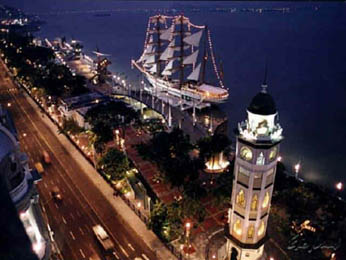


A good turistic place in our country is Malecon 2000 this is next to River Guayas. In this place we can found differents places like stores, souvernirs markets, restaurants and others interesting things to enjoy it.
We also have Barrio Las Peñas, this is at the end of the Malecon2000 and together make a funny place to relax with some friends or in family.

My Classes.

In this course we survey selected American authors representing the major authors, 
literary movements and  fragments of the most significant works of literature 
produced in the U.S. since its beginnings to the present date. It also helps  future 
teachers to improve their reading, communicative and critical thinking skills, letting 
them express judgements and comments about some chapters and creating  a 
greater cultural awareness when exposed to essays, poetry, literary or film 
adaptations of the fragments.

Activity During the semester.

 During this second partial we have studied some movements, in this case we are going to explain the abolitionist movement. "Abolitionist" was the word used in the 19th century for those who worked to abolish the institution of slavery. Women were quite active in the abolitionist movement, at a time when women were, in general, not active in the public sphere. The presence of women in the abolitionist movement was considered by many to be scandalous -- not just because of the issue itself, which was not universally supported even in states that had abolished slavery within their borders, but because these activists were women, and the dominant expectation of the "proper" place for women was in the domestic, not the public, sphere.

One of the most important women abolinist was Sojourner Truth. 


Sojourner Truth 

 
Sojourner began dictating her memories, she spoke about anti-slavery and women´s right.
The Narrative of Sojourner Truth: A Northern Slave was published by Willian Lloyd Garrison.
In 1864, Ohio Woman´s Rights she gave her famous speech with the legendary phrase,

 Ain't I a Woman?


"That man over there says that women need to be helped into carriages, and lifted over ditches, and to have the best place everywhere. Nobody ever helps me into carriages, or over mud-puddles, or gives me any best place! And ain't I a woman? Look at me! Look at my arm! I have ploughed and planted, and gathered into barns, and no man could head me! And ain't I a woman? I could work as much and eat as much as a man - when I could get it - and bear the lash as well! And ain't I a woman? I have borne thirteen children, and seen most all sold off to slavery, and when I cried out with my mother's grief, none but Jesus heard me! And ain't I a woman? "


Source: Book American Literature 5th course MSc. Glenda Morales;

http://www.feminist.com/resources/artspeech/genwom/sojour.htm
http://womenshistory.about.com/od/slaveryto1863/a/abolitionists.htm


  Reflective Learning.

Thanks to our teacher Master Glenda Morales Ramirez de Duchicela we could expand our knowledge and students could interact with the world of american literature and exploring through pictures and presentations, doing questions and controversies. As a result, students may be more more likely to remember concepts and knowledge discovered.

We got some advantages: 
  • promotes motivation
  • promotes autonomy, responsibility, independence
  • the development of creativity and problem solving skills.

Discovery Learning.


Discovery learning is a powerful instructional approach that guides and motivates learners to explore information and concepts in order to construct new ideas, identify new relationships and create new models of thinking and behavior.
Well-designed discovery learning educational sessions are highly experiential and interactive — using stories, games, simulations, visual maps and other techniques to grab attention, build interest and lead a journey of discovery toward new thinking, actions and behaviors. They incorporate three key ideas:
  • Problem Solving: They guide and motivate learners to find solutions by pulling together information and generalizing knowledge.
  • Learner Management: They allow participants, working alone or in small teams, to learn in their own ways and at their own pace.
  • Integrating and Connecting: They encourage integration of new knowledge into the learner's existing knowledge base and clearly connect to the real world.
Discovery learning ensures learners' brains are engaged at all times. Participants may be manipulating pieces on a game board, working with others to make a decision, or gathering seemingly disconnected pieces of information to solve a problem — but they're actually learning!
Discovery learning simply accelerates the educational process and results in higher levels of retention than more traditional learning approaches do. Its benefits are well documented:
  • Training time is condensed
  • Programs are fun, fast-paced and energizing
  • Participants absorb course content via active participation
  • Sessions are highly customizable
  • Retention is high
With training time in short supply, and knowledge in great demand, discovery learning can help organizations offer training that works quickly — and very effectively
.


Objective.


The purpose of this course  is to give intermediate to advanced students the tools, tips and techniques to speak English clearly and accurately. The variety of activities, authentic audios, students´presentations make learning innovative, fun and close to reality that they  will  handle in  elementary and high school settings in Ecuador. This year we are using Focus on Pronunciation Nbr. 3, from Pearson, Longman, as well as several interactive links.


Activity during the semester

This year was our last year in our lovely School of Language, was a very difficult year, but fortunatelly nothing is impossible. We had some subjects, but linguistic was, is and will be the most difficult and important because this subject helped us to be a good students and in the future will be a good English teachers.

At the beggining was very difficult to understand the different rules about Linguistic, because there are many rules to learn and we were confused, but thanks to the excellent explanation of our Teacher Glenda Morales we could understand in a better way.

First we began with differents sounds  like:


 But one of the most important way to improve our pronunciation was Tongue Twisters because it helped us to have a better pronunciation and increase our vocabulary.


In this homework we worked toghether with another classmates to give a good explanation about the differents sound that Tongue Twisters have and differents techniques that served to recognize the methodology that we could use with our students.

This is our Tongue Twister:


/S/ Sound.
Swan swam over the sea.
Swim, swan, swim!
Swan swam back again.
Well swum swan!


In this picture our partner Luisa Herrera is explaining her Tongue Twister.

 Students are doing an exercise to increase their pronunciation
 Differents Tongue Twisters are differents pronunciation and explanation.


 Ernesto is explaining the /s/ sound.

Source: http://www.uebersetzung.at/twister/en.htm


Reflective Learning.-


                                         The reflective learning process
       
Students sometimes view reflective writing as an annoying interruption to the serious business of developing content knowledge in their subject area. However, there are sound reasons why reflective writing is included in student assessment.
       
             "Reflection is indicative of  deep learning, and where teaching and learning activities such as reflection are missing… only surface learning can result."
             Biggs 1999 in King 2002
       
 Reflective writing tasks are given to students to help students learn through reflection, precisely because of the established link between reflection and  deeper learning. As well as facilitating learning and monitoring learning, the intention is to produce graduates who have acquired the habit of reflection as a means of continuing to learn and grow in their professions. Reflection can lead to:
       
         
  •              personal growth
  •              professional growth
  •              meaningful change.
Reflection can help you to:
         
  •              better understand your  strengths and weaknesses
  •              identify and question your underlying  values and beliefs
  •       acknowledge and challenge possible  assumptions on which you base your  ideas,feelings and actions
  •              recognize areas of potential  bias or  discrimination
  •              acknowledge your  fears, and
  •              identify possible inadequacies or  areas for improvement.
        Reflection can lead to greater self-awareness, which in turn is a first step to positive change – it is a necessary stage in identifying areas for improvement and growth in both personal and professional contexts. Taking time to reflect can help you identify approaches that have worked well, and in that way reinforce good practice.


How to Use Improve Tongue Twisters

One way to warm up for stage auditions, rehearsals and performances is by using improv tongue twisters. Read on to learn how how to use improv tongue twisters.

Instructions Stretching
1.      Begin by stretching out the muscles of your face and jaw. Open your mouth as widely as you can.
2.      Now, close your mouth and purse your lips together. Squeeze your mouth tightly so that you're stretching the muscles along your jaw.
3. Repeat until your muscles feel warmed up and ready to work. Three to four times should suffice.

Short Tongue Twisters

4. Begin warming up your tongue by repeating short tongue twisters aloud.        First, try the phrase "Toy boat." When you can say "Toy boat" correctly 10 times in a row, move onto the next twister.

5.      Now, try repeating the phrase "Unique New York." As in the previous twister, this phrase forces you to focus on the vowel and consonant sounds coming from your mouth. When you can say the phrase correctly 10 times in a row, move onto the next twister.

6.      This phrase is a little tricky, because you're implementing two different parts. Try repeating the phrase "Red leather, yellow leather; Good blood, bad blood." This phrase is difficult because it forces you to focus on differentiating between the "b" and the "l" sounds, made by your lips and tongue, respectively. When you can say the phrase correctly 10 times in a row, move onto the next section.

Longer Tongue Twisters

7.      For your first long tongue twister, begin by repeating, "A big black bug bit a big black bear and made the big black bear bleed blood." Because it's a little longer, you may need to read it through a few times before trying it on your own. While repeating the twister, focus on saying each word clearly and correctly. When you can say the phrase correctly two times in a row, move onto the next twister.

8.      Next, try repeating the phrase, "Shy Shelly says she shall sew sheets." Differentiating between the "s" and the "sh" sounds are what makes this step tricky. When you can say the phrase correctly three times in a row, move onto our last twister.

9.      This twister is tricky. Make sure to read it through all the way before you begin to recite it. Try repeating: "Betty Botter had some butter, 'But,' she said, 'this butter's bitter. If I bake this bitter butter, it would make my batter bitter. But a bit of better butter--that would make my batter better.' So she bought a bit of butter, better than her bitter butter, and she baked it in her batter, and the batter was not bitter. So 'twas better Betty Botter bought a bit of better butter." Whew! You might get tongue-tied just trying to read it, but after you've said it a few times without making any mistakes, you know your mouth is ready to handle whatever challenges you're about to face on stage.